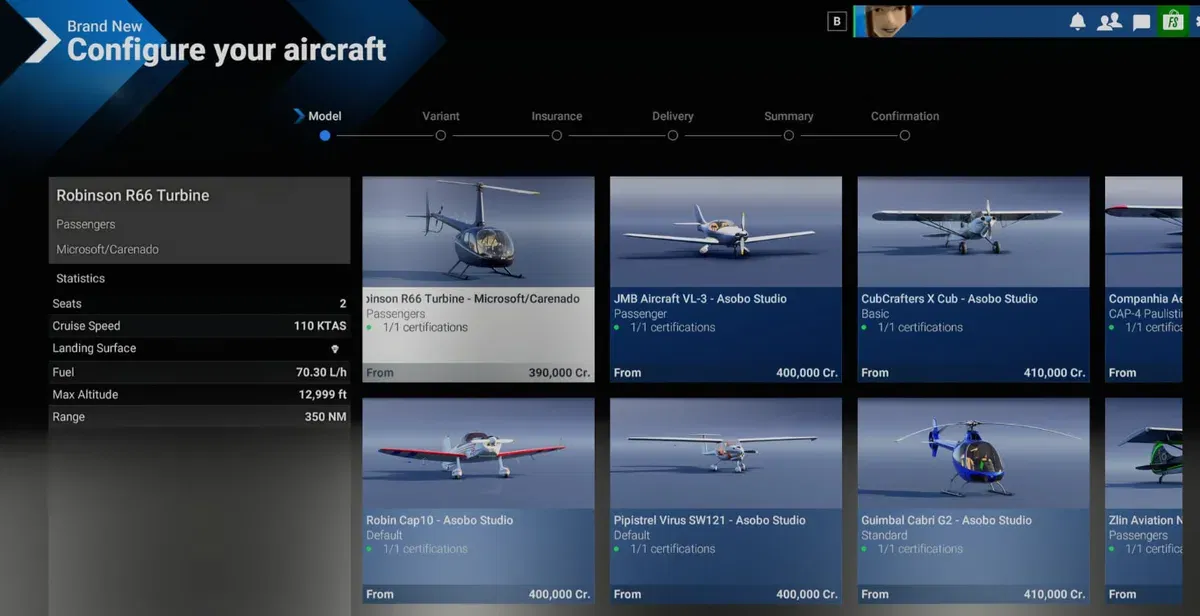
Short answer: Buy a Cessna 172 first — your first company aircraft is discounted to 25,950 credits — then step up to a Cessna 208 Caravan or PC-12 turboprop. Judge every purchase by ROI: price divided by net earnings per hour. Cheap aircraft break even fastest and make the best passive-income fleet. So you've been grinding career mode for a few weeks. You've got some cash, your licences are coming along, and you're staring at the aircraft marketplace trying to figure out what the hell to buy next. Prices range from pocket change to eye-watering, and the game tells you absolutely nothing about which planes are actually worth the investment.
The classic mistake: buying a Citation CJ4 because the cockpit looks cool, burning through savings, finding no jobs to keep it busy, and grinding in a Caravan for fifteen hours to recover. It happens constantly.
Here's the other problem: every guide you find online lists specific prices and earnings that were already outdated before the author finished writing. Asobo patches the career mode economy regularly, and SU4 alone slashed some aircraft prices by over 80%. So instead of giving you numbers that'll be wrong by the next update, this guide teaches you how to evaluate aircraft profitability yourself — a framework that works regardless of what Asobo changes, backed by real data where we have it. (If you're still getting your bearings with career mode overall, start with the main career mode guide.)
Affiliate disclosure: This guide contains affiliate links. If you purchase through these links, SimTuts earns a small commission at no extra cost to you. We only recommend products we genuinely believe improve the flight sim experience.
The Only Formula You Need
Every aircraft purchase decision in career mode comes down to one calculation:
ROI (hours to break even) = Purchase Price / (Hourly Earnings - Hourly Operating Costs)
That's it. Seriously. An aircraft with a low purchase price and decent net earnings breaks even fast. An aircraft with a massive price tag and only slightly better earnings has a terrible ROI, even if the raw numbers look impressive on paper.
Let me walk you through a concrete example. The Cessna 172 Skyhawk has a discounted first purchase price of 25,950 credits. It earns roughly 15-20K per hour and costs a few thousand to operate. Even at a conservative net rate of 12K per hour, it pays for itself in about two hours of flying. That's outstanding.
Now imagine a jet costing 18M that nets 500K per hour. That jet takes 36 hours to break even. The raw earning rate is dramatically higher, but your little 172 is generating pure profit long before the jet has even covered its purchase price.
Jets aren't bad investments — but you need to think about ROI, not just revenue. Once that 36-hour break-even period is over, the jet is printing money at a rate the C172 could never match. The real question is always: can I afford to wait through the break-even period, and is there something better I could do with those credits right now?
What Goes Into "Hourly Earnings"
Your actual hourly earnings depend on several factors:
-
Job availability. Some aircraft types simply have more jobs than others. A plane with no jobs is a very expensive paperweight. Before buying anything, check whether jobs actually exist for that type in the regions you fly. Most players forget this step entirely, and it's arguably the most important one.
-
Job payout rates. Airliners earn more per flight than bush planes, but airliner flights are also longer. What matters is earnings per hour, not per flight. A charter paying 200K that takes two hours is the same hourly rate as a cargo run paying 100K in one hour.
-
Passenger and cargo capacity. More seats or cargo space means higher payouts per trip. Pretty straightforward.
-
Speed. Faster aircraft complete more jobs per hour of real time. A turboprop doing three short hops might earn more per hour than a piston single doing one, even if each individual payout is similar.
-
Route length. Shorter routes mean more takeoffs and landings, which means more wear, more fees, more ATC hassle. But also more job completions and faster reputation building. Longer routes are more fuel-efficient because cruise is cheaper than climb. For airliners, the sweet spot tends to be 1.5-3 hour routes — long enough to maximize cruise efficiency, short enough to finish in a single session.
What Goes Into "Hourly Operating Costs"
Every flight costs you money before you earn a single credit. Most players underestimate these, which is how they end up thinking a plane is profitable when it's actually losing money:
-
Fuel. Usually the biggest variable cost, and the differences are staggering. A 737 burns roughly 2,400 kg per hour. A Cessna 172 burns about 32 litres per hour. That's not a 10x or 20x difference — it can be 50x or more in credit terms. Always check fuel costs before assuming anything about profitability.
-
Maintenance. Aircraft degrade with use, and maintenance scales with complexity and engine type. Turboprops cost more than pistons. Jets cost more than turboprops. And here's the number that should make every aspiring airline owner sweat: one player reports an 8M credit bill to repair a 737 engine (a community economy thread on the MSFS forums). That's a staggering sum that quietly erodes your long-term profits in ways that per-flight earnings never show you.
-
Insurance. Mandatory in career mode. More expensive aircraft have higher premiums. It ticks whether you fly or not, so an aircraft sitting idle is still costing you money.
-
Landing and handling fees. Larger aircraft pay more at airports. Small per-flight, but it adds up over dozens of flights. Frequent short-hop routes accumulate way more landing fees than fewer long-haul flights.
-
Crew wages (for passive income). If you assign an aircraft to crew operations, wages eat a significant chunk of gross earnings. Higher-skill aircraft need higher-paid crews. A Caravan crew costs relatively little. A narrowbody crew takes a much bigger bite. More on this later.
How to Calculate ROI Yourself
Here's the workflow you should follow before any major purchase:
-
Note the purchase price from the marketplace. Write it down. Check whether it's new or used — if used, budget for likely maintenance on top.
-
Fly the type in Employee Mode first. Career mode has no aircraft leasing — the only way to fly something you don't own is Employee Mode, working a few jobs in a company's aircraft. You won't see the true operating costs (the employer covers fuel, insurance and maintenance and pays you a commission), but you'll learn whether you enjoy the aircraft and whether jobs for it actually exist in your regions. That alone prevents most bad purchases.
-
Once you own it, track your total earnings and total costs across your first few real flights — this is the only way to see the true operating picture, since Employee Mode hides owner costs. Be honest about fuel, landing fees, and any maintenance that popped up. Don't cherry-pick your best flight and assume every flight will match it. (Before you commit, community earnings reports for the type are your best proxy.)
-
Calculate your net hourly rate. Total net profit divided by total flight time.
-
Divide purchase price by net hourly rate. That's your break-even time in hours.
-
Compare that number to other aircraft you could buy instead. The one with the lowest break-even time, combined with strong post-break-even earnings, is your best purchase.
Do this every time. It takes 10 minutes of note-taking and basic arithmetic, and it'll save you millions in bad decisions. The players who struggle financially in career mode are almost always the ones buying on gut feel instead of running the numbers.
A Quick ROI Example
Say you're considering a turboprop that costs 2M credits. You buy it (or track a friend's numbers) and fly four jobs:
| Flight | Earnings | Fuel | Fees | Net Profit | Duration |
|---|---|---|---|---|---|
| 1 | 85,000 | 12,000 | 3,000 | 70,000 | 1.1 hrs |
| 2 | 62,000 | 9,000 | 2,500 | 50,500 | 0.8 hrs |
| 3 | 91,000 | 14,000 | 3,200 | 73,800 | 1.2 hrs |
| 4 | 78,000 | 11,000 | 2,800 | 64,200 | 1.0 hrs |
Total net profit: 258,500 credits over 4.1 hours = ~63,000 credits per hour net.
ROI = 2,000,000 / 63,000 = ~31.7 hours to break even.
About 30-35 hours of flying before the aircraft has paid for itself. Whether that's worth it depends on what you're currently earning. If your current aircraft nets 30K per hour, the turboprop doubles your rate and pays for itself in about 32 hours. Clear upgrade. If you're already earning 55K in a different turboprop, that 15% improvement might not justify the 2M outlay — maybe you're better off adding a passive income aircraft instead.
Employee Mode: The Test Drive
Before we get into price changes and passive income, one clarification that trips up a lot of players: career mode has no aircraft leasing. Despite being one of the most-requested features since launch, there's no rent-a-plane system. The only way to fly an aircraft you don't own is Employee Mode — flying missions in a company's aircraft while they cover the costs and pay you a commission.
Use it as your test drive. Before dropping millions on a type, take a few Employee Mode jobs in it (or in the closest thing available). You won't get true owner economics — the employer pays for fuel, insurance and maintenance, and skims the lion's share of the fee — so you can't measure that aircraft's real operating costs this way. But you'll answer the two questions that sink most purchases: do I actually enjoy flying it, and do jobs for this type exist in the regions I fly?
Here's the workflow:
- Fly 3-5 Employee Mode jobs in the type. One flight can be an outlier. You want a feel for the handling and the mission pace.
- Check whether jobs are even there. A gorgeous cockpit with an empty job board is a very expensive paperweight. This is the single most valuable thing Employee Mode tells you.
- Note the marketplace purchase price and research typical earnings — community reports plus your own post-purchase tracking.
- Compare the likely net rate to what you're currently earning. Is the upgrade significant enough to justify the price?
- Only then decide whether to buy.
Employee Mode carries no financial risk, so it's basically free reconnaissance. Spend an evening flying CJ4 jobs for someone else and discovering the light-jet job pool in your region is thin, and you've saved yourself from dropping 3-4M on an aircraft you'd regret.
Players who skip this and buy on forum recommendations often end up disappointed, because those recommendations came from different regions, different routes, or different patches. What you learn from your own flying will always beat someone else's tier list.
Why Prices Change and Why It Matters
If you're reading an aircraft tier list from before SU4, bin it. The economy rebalancing changed prices so dramatically that it reshuffled the entire profitability landscape. And future updates will do exactly the same thing.
What SU4 Changed
The most dramatic shift was massive price deflation on jets and turboprops:
-
Cessna Citation Longitude: Dropped from approximately 34.5M to roughly 6-7M credits — both figures from a community economy thread on the MSFS forums, where a player reports having bought one at 34,500,000 pre-SU4. An 80% price cut. An aircraft that was a terrible investment at 34.5M suddenly became a genuine mid-game contender at 6-7M. Same plane, same capabilities, same earning potential — completely different ROI overnight.
-
Cessna Citation CJ4: Reportedly became about 4x cheaper after SU4. Light jets went from luxury vanity purchases to potentially viable working aircraft.
-
Widebodies now purchasable: The 747-8 and A310-300 became available in career mode with SU4. The Heavy Airliner Rating was locked at the time of writing; Sim Update 5 unlocked all Heavy aircraft specializations, so that restriction is gone.
SU4 also adjusted earning rates and operating costs across the board. Specialist jobs (firefighting, helicopter operations, aerial survey) reportedly saw earning increases, while airline payouts were tweaked to offset the cheaper aircraft prices. The "best" aircraft changed overnight.
Before SU4, the meta was simple: save up for the most expensive airliner you could afford because the earnings were so high that the ROI was still reasonable despite the price tag. After SU4, mid-range aircraft became much more competitive — their prices dropped proportionally more than their earnings did.
Why You Should Care
Don't memorise prices. Learn how to evaluate them.
The specific numbers in any guide — yes, including this one — drift with every patch. But the ROI framework doesn't. An aircraft that costs 6M and nets 200K per hour has a 30-hour ROI whether you read this today or six months from now. The prices and earnings will be different in six months, but the maths is identical.
When a new update drops, spend 10 minutes on the MSFS forums or Reddit checking what changed. Then recalculate. The community documents price changes quickly — usually within days — and you now know exactly what to do with that information. You're not waiting for someone else to write a new tier list anymore. You can build your own.
The Passive Income Efficiency Curve
Career mode lets you hire crews to fly your aircraft when you're not using them. This completely changes the profitability calculation.
The Efficiency Principle
Passive income efficiency (how much an aircraft earns as a percentage of its purchase price per hour) decreases as aircraft get more expensive. Not a guess, not a theory. Here's the pattern from verified data:
-
Cessna 172 (25,950 credits first purchase, 499,800 full price): Earns roughly 2.1-2.18% of its purchase price per hour in passive income. ROI for the first discounted purchase: approximately 46 hours (2.18% of 25,950 is ~566 credits per hour, and 25,950 / 566 = 45.9).
-
Cessna Caravan (~4M new): Lower percentage of its price per hour. Passive ROI: approximately 70 hours.
-
Most expensive aircraft: Passive efficiency drops to roughly 0.7% of purchase price per hour.
Read those numbers again. The cheapest aircraft in the game returns over 2% of its value per hour through passive income. The most expensive? About 0.7%. A 3x efficiency gap — and the implications for fleet building are enormous.
So What Does That Actually Mean?
One Steam guide author put it memorably: "It is more profitable to buy 200 Cessna Skyhawks than one Boeing 737 MAX." The principle is sound on an efficiency basis — the C172 has a far better passive income return per credit invested than any jet. Important caveat: only your first C172 costs the discounted 25,950 credits. The full new price is 499,800 credits, so a fleet of 200 would cost roughly 100M, not 5.2M. Still, even at full price, the per-credit passive efficiency of cheap aircraft dramatically outperforms expensive jets.
Obviously you wouldn't actually buy 200 Skyhawks — job availability has limits and managing that many aircraft would be absurd. But the principle is real: spreading your investment across multiple cheaper aircraft generates more passive income per credit than concentrating it in one expensive plane.
Most players miss this entirely. A fleet of cheap aircraft generating passive income funds your next purchase faster than grinding solo in an expensive plane. And each new aircraft you add accelerates the process further, because the passive income grows while your active earning rate stays the same. It compounds.
The Practical Fleet Strategy
You don't need 200 Skyhawks. Here's the sensible version:
-
Start crew operations early with your first discounted C172 (25,950 credits — subsequent ones cost 499,800 at full price). The discounted first aircraft has a passive ROI of about 46 hours — a couple of days of game time. Full-price C172s take longer to recoup, but still offer the best passive efficiency per credit in the game.
-
Reinvest the passive income. Every credit your crews earn goes toward your next aircraft. The compounding at work here is the single most powerful financial strategy in career mode. Most players don't figure this out until they're 80+ hours in.
-
Add specialist aircraft when you can afford them. Helicopters and firefighting planes often have strong crew earning rates relative to their price.
-
Only add expensive aircraft to your passive fleet last. A 737 is great to fly yourself, but at ~0.7% passive efficiency, it's a poor passive income investment for its cost. For the same price, you could buy an entire fleet of cheaper aircraft generating more total passive income.
The player who builds a fleet of five cheap aircraft generating passive income while flying a King Air reaches the airliner tier faster than the player who skips the fleet and grinds solo toward a narrowbody. The maths on this is unambiguous.
Crew Wages and the Margin Squeeze
One detail that makes the efficiency curve even steeper: crew wages eat into passive income, and they eat proportionally more on expensive aircraft. Higher-skill aircraft need higher-paid crews.
A Caravan crew might consume 25-30% of gross earnings in wages. A narrowbody airliner crew can take 40-50%. So expensive aircraft don't just return a lower percentage of their value per hour — the crew also takes a bigger bite out of what they do earn. The effective gap between cheap and expensive aircraft for passive income is even wider than the raw numbers suggest.
Evaluating Aircraft by Category
Rather than assigning definitive tier rankings with prices that'll be outdated next patch, let's walk through each category with what we can actually verify and skip the stuff that'll be wrong next month.
Starter Piston Aircraft (Under 100K)
What we know: The Cessna 172 has a discounted first purchase price of 25,950 credits. Lowest operating costs in the game. Passive income efficiency of approximately 2.1-2.18% of purchase price per hour, giving it roughly a 46-hour passive ROI. Nothing else in the game touches that passive efficiency.
How to evaluate other pistons: Compare their purchase price to the C172 and ask whether the extra capability — speed, payload, range — justifies the extra cost. A piston costing 3x as much needs to earn roughly 3x as much per hour to match the ROI. Most don't. The Cessna 152 is cheaper but significantly less capable. If you're choosing between them, the C172 wins almost every time.
The Vision G2 is worth a look at 710,000 credits new. But at 27x the price of a C172, it needs to earn dramatically more per hour to break even in a similar timeframe. Run the calculation before you get seduced by the glass cockpit.
Bottom line on pistons: Not exciting. Nobody posts screenshots of their C172 fleet on Reddit. But their ROI is fast because they cost almost nothing. Fly your starter, build cash, and resist the urge to buy another piston when what you really need is a turboprop. The jump from piston to turboprop is the single biggest earning rate increase you'll experience in career mode. Every hour you spend in a piston when you could afford a turboprop is money left on the table.
Single-Engine Turboprops (500K - 2.5M)
What we know: The Cessna 208B Grand Caravan has a new price around 4M credits, with used marketplace prices varying depending on condition and patch. That price range itself is telling — marketplace prices shift with every update, and used prices vary significantly.
Why turboprops are the career mode sweet spot: They're faster and more capable than pistons. Operating costs are manageable — vastly cheaper than jets. Deep job pools with consistent availability. And the purchase prices are low enough that ROI stays fast even with moderate earning rates.
The Caravan is the best value in the game, hands down. It just works — decent cargo capacity, handles well, lands on short strips, and there are jobs for it practically everywhere. It's not glamorous. It won't impress anyone in a screenshot. But it prints money quietly and reliably while flashier aircraft sit idle waiting for jobs.
How to evaluate any turboprop: Check the current price. Fly a few Employee Mode jobs in the type to confirm the work is there, then calculate the ROI from real earnings once you own it. Under 30 hours? Probably a good buy. Creeping above 40? Ask whether you'd be better off buying two cheaper aircraft — one to fly, one for passive income.
Aircraft to consider: The Caravan, Pilatus PC-12, and Daher TBM 930 all occupy this space:
- The TBM 930 is deceptively fast — faster than some light jets — but payload-limited. Great for high-value charter with few passengers, not ideal for cargo.
- The PC-12 does everything well. Versatile, well-rounded, and often cited as the best overall value in this tier. Hard to go wrong with it.
- The Caravan carries decent cargo, handles anything, and has jobs everywhere. The Toyota Hilux of career mode.
Check current prices for all of them, estimate earnings from a few Employee Mode flights or community data, and run the numbers. Don't take anyone's word — including mine — for which is "best." The answer changes every patch.
When to buy your first turboprop: As soon as you can afford one with a 50% cash reserve remaining. Don't drain your account. But don't wait longer than necessary either — every hour in a piston after you could afford a turboprop is costing you the earning rate difference.
Twin-Engine Turboprops (2M - 5M)
How to evaluate twins: Twin turboprops like the Beechcraft King Air 350i earn more per hour than singles but cost more to buy and operate. Higher fuel burn, higher maintenance, higher crew wages.
The question: does the higher earning rate overcome the higher costs enough for a competitive ROI? Often yes, but not by as much as you'd think from the price difference. A PC-12 earning 80% as much as a King Air at 65% of the purchase price might actually have the better ROI. Do the maths rather than assuming bigger is better.
When to buy a twin: When you've already got a single-engine turboprop on passive income, and enough cash to buy the twin with a 50% reserve. The twin becomes your primary while the single works crew duty. You're not replacing your old aircraft — you're promoting it to passive duty.
Get flight sim tips in your inbox
New guides, checklists, and tips — no spam. Unsubscribe any time.
Light and Midsize Jets (3M - 10M)
What we know: SU4 caused massive price deflation here. The Citation Longitude dropped from approximately 34.5M to roughly 6-7M credits — an 80% reduction that fundamentally changed the investment profile. The CJ4 reportedly became about 4x cheaper.
The jet trap (and why SU4 changed everything): Before SU4, jets were terrible investments. They cost nearly as much as airliners but earned far less. A Longitude at 34.5M earning 250K per hour net would take 138 hours to break even. That same Longitude at 6.5M? Twenty-six hours. Same aircraft, same earnings, completely different story.
After SU4, some jets became genuinely competitive with turboprops in the same price bracket. But "competitive" doesn't mean "best." Jets still have higher fuel costs, higher maintenance, and often a thinner job pool. Business jet and VIP charter jobs just aren't as plentiful as cargo and standard charter.
How to evaluate a jet purchase today: Check the current price (it may have shifted again — Asobo keeps tweaking things). Fly a few Employee Mode jobs in it to gauge whether business-jet work exists in your region. Then, once you own it, track actual net earnings per hour and be careful with fuel costs. Jets burn significantly more than turboprops, and the gap is bigger than most players expect.
Then compare the ROI to a turboprop at the same price point. If the jet's ROI is within 20% and you genuinely enjoy flying it, go for it. If the ROI is dramatically worse, you're paying a premium for the jet experience. Nothing wrong with that if you can afford it, but don't pretend it's an investment.
The Longitude specifically: At its post-SU4 price of roughly 6-7M, it became a genuine stepping stone between turboprops and airliners. Good earnings on executive charter and VIP transport, potentially competitive ROI with some twin turboprops. Also just a lovely aircraft to fly — glass cockpit, smooth handling, solid autopilot. If SU4 pricing still holds when you're reading this, the Longitude deserves serious consideration.
The CJ4 specifically: At roughly 4x cheaper than pre-SU4, it moved from "overpriced vanity buy" to "worth a look." Whether it's actually a good investment depends on light jet job availability in your region. Historically thin compared to turboprop jobs, so check before committing. (Gorgeous cockpit. No jobs to fly. A common story.)
Narrowbody Airliners (10M+)
What we know: a community economy thread on the MSFS forums reports 737 MAX earnings of 718,432 credits per hour, though the methodology is unclear — we don't know what routes, what costs were included, or whether that's gross or net. The 737 MAX is the primary narrowbody in career mode, with the A310-300 and 747-8 also purchasable since SU4 (though mission variety for them is still limited).
The airliner calculation is trickier than it looks. Airliners have the highest raw earning rates in the game by a significant margin. But they also have the highest purchase prices and operating costs. And there's a hidden cost that per-flight earnings don't capture: periodic major maintenance.
737 engine maintenance is genuinely brutal: the same thread reports an 8M credit engine repair (pre-SU4). Treat the exact figure as one data point, not a rate card. If an engine needs servicing every few hundred hours, that adds an effective hourly cost of tens of thousands of credits — invisible on any single flight but devastating over the aircraft's lifetime. Before committing, research on the forums what current maintenance intervals and costs look like.
A 737 "earning" 718K per hour gross but costing 100K in fuel, 20K in other costs, and effectively 40K per hour in amortised engine maintenance nets 558K — very different from the headline number. And even that might be optimistic.
The ROI question: Even at 718K gross, the 737 MAX costs tens of millions of credits — reports vary from around 44M used to 99M new, and prices shift with every patch. At those prices, you're looking at well over 100 hours to break even depending on real operating costs. That's a long time just paying back the purchase price. Manageable if you've got passive income covering expenses. Dangerous if the airliner represents most of your wealth.
When to buy your first airliner: When you have at least 30-50% more than the purchase price in the bank AND a passive income fleet already running. Never spend your last credit on an airliner. A player who buys a narrowbody with exactly enough credits is one bad landing and one engine repair away from financial ruin. The forums are full of this exact story and it's painful to read.
Widebody Airliners — Not Yet Available
Since SU4, the 747-8 and A310-300 are purchasable in career mode, and SU5 unlocked the Heavy aircraft specializations that previously limited what you could fly them for. The 737 MAX remains the most practical airliner for earning credits, but the widebody path is starting to open up.
Specialist Aircraft: Helicopters and Firefighting
What we know from forum sources:
- The Erickson S-64 Air Crane is reported at 258,065 credits per hour on construction and heavy-lift contracts (same thread).
- The Canadair CL-415 (Superscooper) is reported at 370,164 credits per hour on firefighting missions (same thread).
Both figures come from community sources with limited methodology, so treat them as ballpark estimates. But even with a healthy margin of error, those rates are impressive relative to purchase prices.
Why specialists can be excellent investments: They often deliver better ROI than their price tier suggests because earnings are disproportionately high relative to cost. The CL-415's reported hourly rate would give it one of the best ROIs of any aircraft over 1M credits. The S-64 is a strong candidate for passive income — short, repetitive jobs are ideal for crew efficiency.
The catch: Specialist jobs aren't always there. Firefighting missions are regional and seasonal. Helicopter contracts depend on location. A specialist aircraft sitting idle because there are no jobs earns exactly zero credits while still costing you insurance.
Before buying, make sure you've built reputation in that specialty and can access jobs consistently. Fly a few Employee Mode missions in the type first to confirm the work is there.
How to evaluate specialist aircraft: Same ROI calculation as everything else, plus a "job availability factor." If you can realistically fly specialist missions only 60% of the time and need lower-paying general jobs the rest, adjust your expected hourly rate downward. Even with that adjustment, specialists often come out ahead — the earning rates when jobs are available are that good.
Helicopters as a career path deserve special mention. Rotary-wing is a completely separate progression with its own jobs, licences, and reputation tracks. If you enjoy helicopter flying, the earning potential is strong — the S-64 at 258K per hour competes with fixed-wing aircraft costing far more. The Guimbal Cabri G2 is your entry-level piston helicopter (requires CPL-Rotorcraft at 3,500 credits), and the Airbus H125 unlocks with your turbine rating — both are solid ways to test whether you like rotary before committing to an expensive Air Crane. Fly a few Employee Mode rotary jobs first.
Firefighting as a career path is something I'd encourage everyone to try at least once. The CL-415's reported 370K per hour is exceptional for its price range. But beyond the money — scooping water from lakes at low altitude and dropping it on fires is genuinely one of the most engaging things you can do in the entire sim. The gameplay loop is short and satisfying, nothing like the occasional monotony of hour three on a long-haul route. Try a few Employee Mode firefighting runs before dismissing the CL-415 as niche.
Mixed fleets across specialties are the most resilient approach. A fleet with turboprops, a firefighting aircraft, and a helicopter is less vulnerable to any single job market drying up. If airliner jobs get nerfed next update, your specialists keep earning. If helicopter contracts dry up in your region, turboprops pick up the slack. Spreading your bets works.
The Maths of Fleet Building: A Worked Example
The passive income stuff above might feel abstract, so let's walk through a concrete scenario with real numbers.
The Solo Grinder vs. The Fleet Builder
Two players, both starting with 500K credits and a turboprop earning 80K per hour net.
Player A (Solo Grinder) flies every session in their turboprop, saving every credit for a 737 MAX. At 80K per hour, that could easily be 500+ hours of flying to save up for a new airliner costing tens of millions. A lot of evenings in a Caravan.
Player B (Fleet Builder) spends 26K on a C172 for crew operations immediately. That C172 starts earning roughly 560 credits per hour in passive income (2.18% of 25,950). Sounds tiny. It adds up — and more importantly, it's free money that compounds.
After about 46 hours, the C172 has paid for itself. Player B buys a second. Now passive income is 1,120 per hour. Still small, but growing. By the time Player B has 5 cheap aircraft on crew duty, the crew earnings start to matter — maybe 3-5K per hour of active flying, layered on top of every mission they fly.
One thing to understand: crew income in career mode is not truly idle. It scales with how much you actively fly. The game calculates each crew aircraft's daily earnings as its pay rate multiplied by the time you spent flying freelancer missions in the last 24 hours — so your crew only earns while you're flying too, and you log off before midnight UTC to bank it. It's still a huge multiplier: every hour Player B flies their main aircraft, five crewed planes earn alongside it. Player A, flying the same hour, earns from one aircraft only. By hour 100+, Player B's crew income has funded multiple additional purchases, each adding another earner to every flight. The gap compounds relentlessly.
Why This Works
Passive income is near-free money. You earn it while flying your main aircraft — every freelancer mission you fly also pays out across every crewed aircraft in your fleet. It isn't fully hands-off (your crew only earns in proportion to your own flight time, banked daily before midnight UTC), but every credit it generates is a credit you didn't have to earn on a separate flight.
The 2.1% efficiency rate on cheap aircraft is the engine that drives everything. A C172 returning 2.1% per hour pays for a second C172 in about 46 hours. Two fund a third in 23 hours. Three fund a fourth in 15 hours. The fleet grows exponentially, and each new aircraft is essentially free — funded entirely by the ones before it.
You'll eventually hit a ceiling where job availability limits how many cheap aircraft can earn simultaneously. But by then you've got a fleet generating significant background income and can start adding pricier aircraft (with their lower efficiency) because you can afford the longer ROI.
The Practical Takeaway
Buy your first passive income aircraft before your second active one. A C172 at 25,950 credits is the cheapest investment in the game, and its 46-hour ROI means it starts contributing early. Then buy your upgrade turboprop. Then add more passive aircraft. Then your twin. The fleet-first approach is slower to show results in the first few hours, but it overtakes the solo grind within 50-100 hours and never looks back.
Used vs. New Aircraft: The Hidden Trap
Career mode lets you buy used aircraft at a discount. Sounds great on the marketplace screen. In practice, it often isn't.
The Problem With Used Aircraft
Used aircraft come with wear and accumulated maintenance needs. A used plane listed at 30% off might need immediate work costing 20% of the new price. Your "bargain" saved you 10%, barely worth the risk.
The Caravan illustrates this perfectly. Used prices range from roughly 1.6M to 2.3M depending on condition and market state. A 1.6M Caravan in "Fair" condition with deferred maintenance could easily need 200-400K in work before it flies reliably. A 2.3M Caravan in "Good" condition might actually be the better deal because you can fly it immediately and start earning.
When Used IS a Good Deal
Worth buying when:
- Condition is "Good" or better. "Fair" or "Poor" almost always means repairs that eat the discount and then some.
- The discount exceeds 30%. A 10-15% discount rarely covers inevitable maintenance. You need a meaningful gap between used and new to absorb the risk.
- You actually inspect it first. Career mode shows condition in detail. Read it carefully. Multiple systems flagged? Walk away.
- It's a simple aircraft type. A used C172 with cheap maintenance — fine, worst case is still pocket change. A used jet with deferred engine work? Financial black hole. Remember that reported 8M engine repair on a 737. A "bargain" used 737 needing engine work is the most expensive mistake you can make in this game.
The Rule of Thumb
If a used aircraft costs more than 75% of new price, buy new. The peace of mind of no deferred maintenance is worth 25%. Below 70% in good condition, it can be a smart buy — but inspect carefully and budget for at least one surprise repair.
The Optimal Buy Order (A Framework, Not a List)
Rather than telling you exactly which aircraft to buy at which price, here's the decision framework for each stage. The specific best-fit aircraft will shift with patches, but the logic doesn't.
Stage 1: Under 500K Credits
Fly your starter aircraft. Build cash and reputation across multiple job categories. Don't buy anything unless you find a turboprop you can afford with 50% cash remaining. Use this time to experiment — cargo, charter, bush work — and figure out what you enjoy and what pays best in your regions.
Buy a C172 for passive income immediately. At 25,950 credits, it's negligible even at the earliest stage, and the 46-hour passive ROI means it starts contributing early.
Your first major upgrade should be piston to turboprop. Biggest earning rate jump in career mode. The Caravan has historically been the go-to, but check current prices. Whatever turboprop has the best ROI when you're buying is the right choice. Fly a couple of Employee Mode jobs in two or three of them before committing.
Before buying, calculate: Does the ROI beat what I'm earning now by enough to justify the credits? Under 15 hours? Almost certainly worth it — that's two or three sessions to break even, and everything after is profit at a higher rate than you've ever earned.
Stage 2: 500K - 3M Credits
Your primary earner is a turboprop. You're saving for either a better turboprop or your first twin.
Start passive income now if you haven't already. Most players delay this way too long. Buy a C172, assign it to crew. Assign your old starter too if you still have it. Every credit these aircraft earn in the background accelerates your progression.
Second purchase: a higher-earning turboprop or a twin. PC-12, King Air, whatever's priced competitively right now. ROI under 30 hours is good, under 20 is excellent. When you upgrade, move your old turboprop to passive duty — don't sell it.
Stage 3: 3M - 10M Credits
You should have 3-5 aircraft by now — one you fly actively, the rest earning in the background.
Consider specialist aircraft if you've built reputation in firefighting, helicopters, or other niches. The CL-415 and S-64's reported earning rates could seriously boost your income. Run the ROI with current prices and factor in job availability.
Consider a mid-range jet if post-SU4 pricing still makes them competitive. The Longitude at 6-7M is a completely different proposition than at 34.5M.
Resist the airliner urge. You probably don't have enough reserves to absorb the break-even period comfortably. A player who buys a 737 with 20M and no passive fleet has no margin for error and no income during the payback grind.
Stage 4: 10M+ Credits
Airliner territory — but only when you have 30-50% more than the purchase price in the bank. You need reserves for fuel, maintenance, insurance, and those engine bills.
After your first 737 MAX pays off, you've got options:
- Second 737 for crew operations. Financially optimal — a crew-operated 737 generates significant passive income even at the lower efficiency rate, because absolute earnings are high.
- Expand your specialist fleet. If the CL-415 or S-64 has been performing, another specialist diversifies your income sources.
- Consider widebodies. The 747-8 and A310-300 are now purchasable (since SU4), though mission support is still limited. You'll be well-positioned when full Heavy Airliner missions arrive.
- Try new aircraft types. Asobo regularly adds planes to career mode. Each new addition is a chance to apply your ROI framework and find the next underpriced gem before the community catches on.
At this point, you know the economy well enough to make your own calls.
What About Selling Aircraft?
Comes up a lot. Should you sell aircraft you've outgrown?
When to Sell
- It's sitting idle with no crew and you're not flying it. Dead capital. Sell and reinvest.
- You need cash for an upgrade and you've calculated that the upgrade's earning rate more than compensates for losing the old aircraft's contribution. Selling a PC-12 to fund the last million toward a 737 can make sense if the 737 dwarfs what the PC-12 was generating.
- A patch killed its profitability. If an update nerfs earning potential or job availability, holding it is sentimental, not strategic.
When to Keep
- It's generating passive income. An aircraft earning 500 credits per hour is still better than 0 credits sitting as cash. Cash doesn't compound. Passive income does.
- It fills a niche nothing else can. Your bush plane might not earn much, but if it's the only thing that can access those remote high-paying contracts, selling it means losing that entire job category.
- Resale value is poor. You rarely get back what you paid. If the resale value is significantly below what the aircraft would earn over the next 50 hours of passive duty, keep it.
The General Rule
Default to keeping and assigning to crew. Only sell when you have a specific, calculated reason. Most players sell too early and then have to re-buy the same aircraft later at full price. It happens more than you'd think.
Common Mistakes to Avoid
The "Biggest Number" Trap
Players see a jet earning 500K per flight and think "that's amazing." Then the jet cost 15M, burns 80K per flight in fuel, and needs millions in engine maintenance every few dozen hours. Suddenly the Caravan earning 40K per flight with negligable costs doesn't look so bad. Always compare ROI, not revenue.
The "Skip the Middle" Trap
Some guides tell you to grind in a C172 until you can afford an airliner directly. Mathematically inferior to the turboprop progression. A player who buys a turboprop early and builds passive income reaches the airliner tier faster than one hoarding every credit from C172 flights. Passive income compounding is the difference between linear and exponential progression.
The "Pre-SU4 Advice" Trap
If someone tells you to "save up 35M for a Longitude" or quotes any pre-SU4 price, they're working from wildly outdated info. SU4 caused massive price deflation on jets and turboprops. Always check current marketplace prices before acting on advice from forums, Reddit, or YouTube — no matter how many upvotes it has.
The Vanity Purchase
Any aircraft you buy because it looks cool rather than because it earns well. Business jets in the 3-8M range are the worst offenders — expensive to buy, expensive to run, and the job pool is often thinner than turboprops or airliners. Want to fly a business jet for fun? Fly one in Employee Mode, or just take it up in free flight — both cost you nothing. Don't buy unless the ROI supports it.
Ignoring Maintenance Costs
Subtle but devastating over time. Players track fuel costs because they're visible and immediate. Maintenance costs are deferred — they build up silently and then hit you all at once. A 737 that appears to net 600K per hour might actually net 500K when you amortise engine maintenance across its service life. Always ask: what are the major maintenance costs, and how often do they occur?
Spending Your Last Credit
Never buy an aircraft that leaves you with less than 30-50% of the purchase price in reserve. You need that buffer for fuel, maintenance, insurance, and the inevitable surprise repair. A player who buys a narrowbody with exactly enough credits is one engine failure away from being unable to afford repairs. That reserve isn't optional — it's the difference between a temporary setback and a career-ending financial spiral.
Verified Data Summary
Every data point in this guide that we can verify or source:
| Data Point | Value | What It Tells You |
|---|---|---|
| C172 first purchase price | 25,950 cr | Cheapest entry point, excellent passive ROI |
| C172 passive income efficiency | ~2.1-2.18% of price/hr | Cheap aircraft have the best passive ROI |
| C172 passive ROI | ~46 hours | Fastest break-even on passive income |
| Caravan new price | ~4M cr (used varies) | Check marketplace for current used prices |
| Caravan passive ROI | ~70 hours | Good but 3x slower per credit than C172 |
| Vision G2 new price | 710,000 cr | Mid-range option; evaluate ROI before buying |
| Longitude post-SU4 | ~6-7M cr (was ~34.5M) | SU4 caused 80%+ drops on some jets |
| CJ4 post-SU4 | ~4x cheaper | Jets became dramatically more accessible |
| 737 MAX new price | ~99M cr (varies with patches) | Check marketplace for current price |
| 737 MAX earnings | ~718K cr/hr (single source) | Highest reported rate; methodology unclear |
| 737 engine maintenance | ~8M per engine (one report) | Massive hidden cost on airliners |
| Widebodies (747-8, A310-300) | Purchasable since SU4 | Heavy specializations unlocked in SU5 |
| CL-415 earnings | ~370K cr/hr (forum source) | Specialist aircraft can earn very well |
| S-64 earnings | ~258K cr/hr (forum source) | Helicopters have strong earning niches |
| Expensive aircraft passive efficiency | ~0.7% of price/hr | 3x worse efficiency than cheap aircraft |
Some of these numbers come from single sources with unclear methodology. Some are verified first-hand. All will shift with future updates. The framework for using them doesn't change.
How to Stay Current After Updates
The economy changes with every system update. Here's how to keep up without waiting for guides that go stale:
-
After every update, check the MSFS forums and r/MicrosoftFlightSim for economy change reports. The community documents price changes within days.
-
Spot-check your fleet's ROI by flying a few jobs in each aircraft and recalculating. If an aircraft's ROI has gotten dramatically worse, consider selling and buying whatever replaced it in the meta.
-
Check used marketplace prices before buying. Prices fluctuate with patches, and one update can be the difference between a great deal and a terrible one.
-
Share your own data. The community benefits enormously when players post verified earnings and costs with clear methodology. Your three carefully tracked flights in a post-update aircraft are worth more than a year-old tier list built on unverified numbers. Be the data you want to see.
What Survives Every Patch
Asobo will keep tweaking the economy. Prices, earnings, and operating costs will shift with every update. But a few things hold regardless:
Always calculate ROI before buying — raw earnings mean nothing if the break-even takes forever. Cheaper aircraft almost always have faster ROI, which is why a fleet of turboprops will outperform a single widebody in capital efficiency every time. Get passive income running early because it compounds — every crew aircraft accelerates your path to the next purchase. And never spend your last credit. Keep 30-50% as buffer, because the next patch might change everything.
The career mode economy is designed to tempt you into spending money you shouldn't on aircraft you don't need yet. The most profitable path is rarely the most glamorous. Flying a turboprop for 30 hours before upgrading isn't as exciting as saving for a 737. But the player who builds passive income, evaluates every purchase with the ROI formula, and resists vanity buys reaches the 737 faster than the one who tries to skip the progression.
Run the numbers. Build the fleet. Fly smart.
Frequently Asked Questions
What aircraft are available in MSFS 2024 career mode?
Career mode unlocks aircraft as you earn licences and ratings. Your first purchasable light singles sit around the Cessna 152 and 172 Skyhawk. Single-engine turboprops like the Cessna 208 Caravan open up once you hold your Commercial licence and Instrument Rating; twins such as the Beechcraft King Air, Britten-Norman Islander and Baron require your Multi-Engine rating. Jets arrive with your type ratings — Citation CJ4 and up — and airliners like the Boeing 737 come with the ATPL and a jet type rating on top. The exact roster depends on your DLC and which World Updates you have installed, but the progression above is the core career path every pilot takes.
How do you buy aircraft in MSFS 2024 career mode?
Open your company screen, click the aircraft marketplace (or "Acquire Aircraft"), and filter by category. Each aircraft shows a purchase price and unlock requirements — you cannot buy airframes that need ratings you have not yet earned. Your very first aircraft in your first company comes with a one-time discount of around 90% — the Cessna 172 drops from 499,800 to roughly 25,950 credits. It applies only to that single purchase, not to every aircraft type, so do not waste it on an aircraft you will not fly often. Once bought, aircraft live in your company hangar and can be assigned to missions individually.
How much do aircraft cost in MSFS 2024 career mode?
Prices range from around 25,950 credits for your discounted first Cessna 172 up to tens of millions of credits for airliners (community reports put the 737 MAX anywhere from the mid-40M range used to roughly 99M new). Asobo has patched aircraft prices several times — SU4 cut some by over 80% — so any specific number you read online is probably out of date. What has not changed is the principle: cheap aircraft with fast ROI (break-even in 2-5 hours) almost always beat expensive aircraft with long payback periods. Use the ROI formula above rather than chasing specific prices.
Which are the best planes in MSFS 2024 career mode?
The Cessna 172 Skyhawk and Cessna 208 Caravan are near-universally the two most profitable aircraft in the game. The 172 pays for itself in roughly two hours and stays useful long after you can afford bigger aircraft. The Caravan unlocks with your Commercial licence and Instrument Rating and handles cargo, medical, and short-haul passenger missions extremely well — often beating jets on pure profitability because operating costs stay low. The Beechcraft King Air 350 is the next step for pilots who want turboprop speed without jet operating costs. Avoid buying jets purely for status — they only pay off if you consistently fly long, well-paid missions.
What's the best first aircraft to buy in MSFS 2024 career mode?
The Cessna 172 Skyhawk, thanks to a one-time discount that drops your first company aircraft from 499,800 to roughly 25,950 credits. It has the lowest operating costs in the game, pays for itself in about two hours of flying, and then delivers the best passive income return per credit of any aircraft — around 2.1% of its price per hour, or a roughly 46-hour passive break-even. The discount applies only to that single purchase, so spend it on a 172 you'll actually fly and assign to crew rather than a pricier plane you'll rarely use.
Can you try an aircraft before buying it in MSFS 2024 career mode?
Yes — through Employee Mode, which lets you fly missions in a company's aircraft while they cover fuel, insurance, and maintenance and pay you a commission. Career mode has no aircraft leasing or rental, so Employee Mode is the only way to fly something you don't own. Use it as a free, no-risk test drive: fly three to five jobs in the type to confirm you enjoy it and that jobs for it actually exist in the regions you fly before spending millions. You won't see true owner operating costs this way, but you'll avoid the most common bad purchases.
How do you make money fast in MSFS 2024 career mode?
Three rules: (1) buy aircraft with short ROI rather than impressive cockpits, (2) chain missions so you fly back to bases where the next job waits instead of deadheading empty, and (3) never skip a mission step, because a skipped flight phase is deducted as a Skip Cost and the ratings multiplier rewards completeness more than raw speed. Once you have a profitable aircraft, the fastest accelerant is earning ratings that unlock better-paying mission types (IFR, Multi-Engine, Type Rating) rather than buying a bigger plane.
Does career mode get harder as you progress?
Yes — but mostly in operating complexity rather than pure difficulty. Light singles are VFR-only and forgiving. Turboprops need you to manage fuel, weight, and approach speeds more carefully. Jets demand accurate FMS programming (use our free A320 MCDU trainer or Boeing 737 CDU trainer to practise without loading the sim). Airliner missions add passenger satisfaction scoring, stricter time windows, and multi-leg flight planning. The sim rewards preparation at each tier.
More Career Mode Guides
- Career Mode Guide — licences, checkrides, career paths, and the full progression from student pilot to ATPL
- Career Mode Money Guide — company economics, the Skip Cost, when to expand, and how to stop haemorrhaging cash
- Passive Income Guide — crew operations, the midnight UTC trick, and building a fleet that earns while you fly
- Best Hardware for Airliners — yokes, sidesticks, throttles, and pedals at every price point — makes a real difference once you're flying the 737 or King Air
Recommended reading: If the economics of fleet building and airline profitability interest you beyond the sim, Hard Landing by Thomas Petzinger is the real-world version of what you've just read — the epic story of how airline executives battled for profits, market share, and survival. Reads like a thriller and it'll change how you think about route economics.