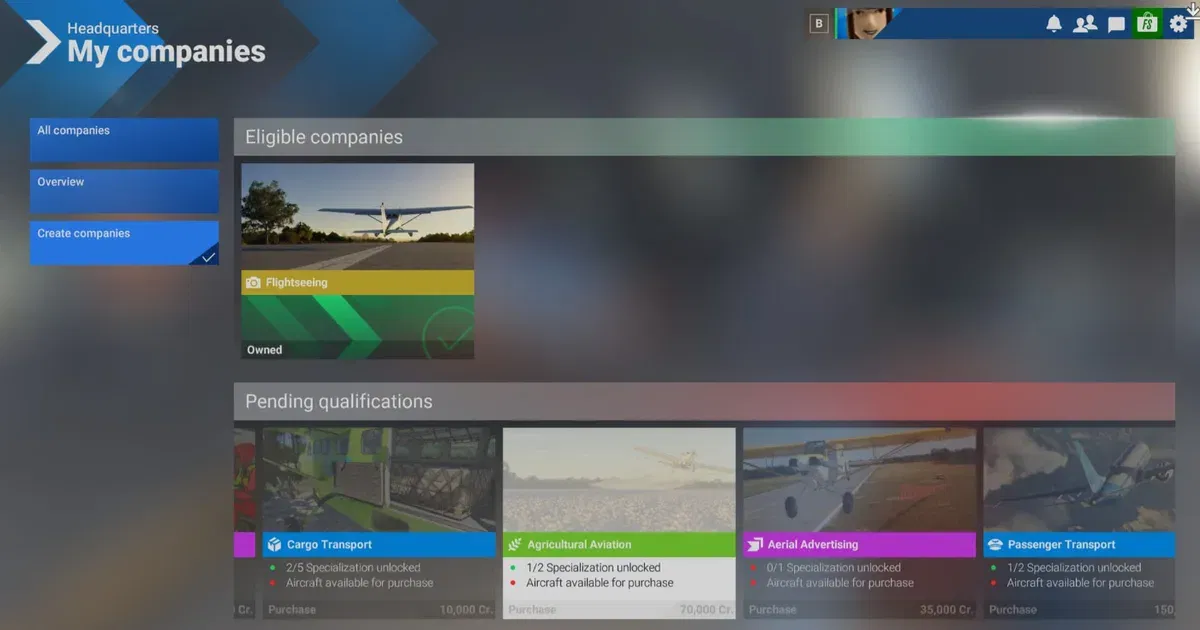
So you've been flying career mode for a while. You've got your licences. You're completing missions. And you're... still broke.
Every time you check your bank balance it's roughly the same as it was twenty flights ago. Money comes in, sure, but it bleeds right back out through fuel, maintenance, insurance, and costs you didn't even know existed. Most players spend their first forty hours in exactly this loop — flying constantly, earning what feel like decent payouts, and somehow never getting ahead.
This guide is about fixing that. It's not about which licences to get or how to grease a landing — if you need that, read the MSFS 2024 career mode guide first. This one is purely about money: how to earn it, how to stop haemorrhaging it, and how to build a company that actually turns a profit.
One caveat before we dive in: the career mode economy changes with patches. Asobo has adjusted prices, payouts, and mission durations in past updates (SU4 was a big one), and they'll almost certainly do it again. So rather than giving you a spreadsheet to memorise, I'm going to teach you how to think about the economy. The principles survive patches. Specific numbers might not.
Affiliate disclosure: This guide contains affiliate links. If you purchase through these links, SimTuts earns a small commission at no extra cost to you. We only recommend products we genuinely believe improve the flight sim experience.
The Starting Position
You begin career mode with 5,000 credits. Your Private Pilot Licence costs 2,000 and your Commercial Pilot Licence costs 2,500. That doesn't leave much breathing room, so every credit matters early on.
And honestly? That tightness is intentional. You're meant to freelance, fly cheap planes, and learn how the economy works before dropping serious money. Players who try to rush past this phase almost always end up broke and frustrated. I know because I was one of them.
Phase One: Freelancing
Before you even think about starting a company, you need to understand freelancing. It's where most of your pre-company flying happens, and most players leave money on the table because they don't understand what's actually happening under the hood.
Quick note on where you actually begin: your very first flights are in Employee Mode, flying aircraft owned by other companies. You don't pay for fuel, maintenance, or insurance, but the operator takes the vast majority of each mission's fee, so the money you keep is small. Once you own an aircraft, Freelancer missions open up — these are the jobs you fly in your own plane, and that's where the real earning starts.
As a freelancer you pick up jobs from the board, fly them, and get paid. Simple. But that payout number on the listing? It's not the full picture. There are multipliers, bonuses, and hidden mechanics that can massively boost your earnings — or gut them entirely.
How Freelance Payouts Work
Every job has a base payout determined by:
- Distance — longer routes pay more, roughly proportional to nautical miles
- Cargo weight or passenger count — heavier loads and more passengers mean higher base pay
- Job complexity — IFR pays more than VFR, night more than day, bad weather adds a premium
- Aircraft type required — jobs demanding more capable (read: expensive) aircraft have higher base payouts to compensate
Then on top of that, you've got bonuses:
- Performance score from flying a clean flight with a decent landing
- Reputation tier bonus — higher rep in a category means better pay on every job in that category
- The Skip Cost — a deduction rather than a bonus since Sim Update 6, and the one worth its own section
The Skip Cost: What Skipping Actually Takes
Read this before any other guide's numbers, including this one's older ones. In Sim Update 6 (August 2026) Asobo "[r]eplaced 'No Skip Bonus' with 'Skip Cost' in mission reward screen and change how it is calculated". Two things went at once: the framing (money deducted, not money awarded) and the arithmetic behind it. Every specific percentage written before August 2026 — the 45%, the 85%, the multipliers in old forum threads — describes a system that is gone. Asobo did not publish replacements, so nobody can honestly quote you a number for the current one.
What the reward screen tells you is per-mission. It prices the flight phases you skipped inside that mission using the Skip button, and that is the thing to avoid. The older lore about a streak running across missions — decline a job from the board and your bonus resets for the flights afterwards — was never more than a forum reading of the old bonus line, and it does not match what SU6 itemises. Declining a job you are not equipped to fly is not what costs you money.
So the strategy is simpler than it used to look, and it survives the change: fly the phases. Boring cruise is what sim rate is for (next section but one — it costs you nothing). The Skip Cost line on your own reward screen is now the only authority on what a skip took, and it is right there after every mission.
When Declining a Job Is Right
Turning a job down on the board is not a skip and does not appear on any reward screen. The judgement is only about risk and opportunity cost.
If the job board's offering you a sketchy mountain bush landing in terrible weather and you know there's a real chance you'll crash, decline it. A crashed aircraft costs more than any mission's payout.
But be honest with yourself about risk. "I might not land perfectly" is not a reason to skip. "I've never landed on a 1,800-foot strip at 6,000 feet elevation in a crosswind and I will probably wreck the aircraft" — yeah, skip that one.
How to Think About Freelance Earnings
Forget memorising payout tables (they change with patches anyway). Instead, evaluate missions by asking three things:
-
What will this actually pay after bonuses? Check the estimated payout, and remember that the weather and performance bonuses routinely matter more than the base pay on the board.
-
What's it going to cost me? Fuel is your biggest variable. A quick VFR hop in a C172 costs almost nothing. A two-hour IFR flight in a turboprop costs a lot more. Factor it in.
-
What's my credits-per-hour? Divide expected profit by expected flight time. Two short VFR cargo runs at moderate pay often earn more per hour than one long IFR haul, once you account for fuel and time.
The sweet spot for early-game grinding is short VFR cargo and charter runs. Quick (15-30 minutes), low risk, and the per-hour rate is often better than longer missions that look sexier on paper. Light cargo typically pays somewhere in the 30,000 to 90,000 credit range per flight. Charter work in something like a Vision G2 on a 20-30 minute run can hit 150,000 to 250,000 credits. These numbers shift with patches, so always check the board yourself.
Don't Rush Past Freelancing
Think of freelancing as your training wheels for the economy. You're learning how money flows, what costs eat into your margins, and how to stay consistent. You're also building the two things you need before starting a company: capital and reputation.
Don't try to rush past this. Players who jump into company ownership too early almost always regret it. Company overhead will eat you alive if you don't have enough capital to absorb a few bad weeks.
When to Start a Company
Everyone asks this too early. There's no magic credit number — you need a few things to line up at once.
The Company Readiness Checklist
You're ready when:
-
You have comfortable working capital. A cargo company costs 10,000 credits to purchase. But that's just the entry fee — you also need enough to cover operating costs (fuel, maintenance, insurance) for your first stretch of flying before revenue catches up. If buying the company would leave you with barely anything in the bank, wait.
-
You've built decent reputation in the category you plan to operate in. Rep affects what contracts your company can bid on. Low rep means low-paying contracts that barely cover operating costs.
-
You have a CPL. Some company types technically only need a PPL, but the jobs available at PPL level rarely generate enough revenue to cover company overhead. The CPL is 2,500 credits.
-
You own or can afford an appropriate aircraft. Your first aircraft purchase is discounted — a C172 can be had for 25,950 credits as a first buy. But think about whether a C172 is actually the right tool for what you're planning. A cargo company might need something with more capacity.
-
You understand the costs. If you can't roughly list your major expense categories (fuel, maintenance, insurance), you're not ready. Read the costs section below.
What Happens When You Start Too Early
Let me paint the picture because I've lived it.
You open a cargo company feeling optimistic. Buy the company, buy an aircraft, and suddenly your bank balance is near zero. First few contracts bring in decent revenue, but fuel and maintenance eat into every flight. Then one bad weather week where you can't fly, or one incident that needs repairs, and you're done. Can't afford to fly, can't afford not to fly, and fixed costs keep ticking. You dissolve the company, lose most of your startup costs, and go back to freelancing with less money than you started with.
Don't let this happen to you.
Which Company Type to Start
Career mode offers several company types, each with different economics. Your first company matters because getting it wrong means burning through your startup capital for nothing.
Cargo: The Best Starter Company
Cargo. Start with cargo. I know it's boring but trust me.
The community consensus backs this up, and here's why it works:
Why cargo is forgiving:
- Cargo doesn't complain about turbulence. No passenger satisfaction scores to stress over.
- Demand is consistent pretty much everywhere
- Delivery windows are relaxed enough that you won't panic
- It scales naturally — more routes, bigger aircraft, same fundamentals
- Your landings can be ugly. Nobody cares as long as the cargo arrives intact.
The downsides:
- It can feel repetitive. You are literally running a delivery service.
- Heavy loads mean higher fuel costs and more wear on your aircraft
The real reason cargo works as a starter is the margin of error. Charter operations punish you for every bump and hard landing through passenger satisfaction scores, which directly affect your reputation and future contracts. Cargo doesn't care. You can have a firm landing, hit some chop, take a slightly inefficient route, and as long as the cargo arrives intact and on time, you get full pay.
Medium cargo missions are designed to pay around 1,000,000 credits per flight at time of writing, though these are longer flights needing more capable aircraft. Light cargo runs pay significantly less (30,000-90,000 credits) but they're quicker and cheaper to operate. Match your aircraft and costs to the contract value.
Charter: Higher Ceiling, Higher Risk
Charter companies fly passengers. Better payouts than cargo on a per-mile basis, but the scoring is stricter and the consequences of a bad day are worse.
The money is better — higher base payouts, passengers leave reviews that build your rep faster, and you get more variety in destinations.
But passengers are fussy. Hard landings, turbulence, delays — all of it tanks your satisfaction scores, which directly affect future contract quality. Insurance costs more because you're carrying people. Weather cancellations hurt your reputation. And "consistently smooth flying" is harder than it sounds when you're doing it across dozens of flights.
Charter is the better long-term company type for experienced players. But as a first company, the risk of reputation damage from a few bad flights can snowball fast. Save it for your second company, after you've learned ownership economics with cargo.
Sightseeing: Niche but Viable
Sightseeing companies offer scenic flights. Short routes, low fuel costs, passengers who are generally in a good mood because they're on holiday.
It can work in the right region. But the per-mission payouts are low — you make money on volume, not individual flights. Very location-dependent too, and it scales poorly. There's a ceiling. Not a reliable first company for most players unless you're in a tourist hotspot and willing to fly constantly.
Medevac: Specialized and Stressful
Medical evacuation. High urgency, specific aircraft requirements, tight time windows.
The payouts are excellent and the missions feel meaningful in a way most career mode work doesn't. But it requires expensive aircraft with medical equipment, the time pressure is real, scheduling is unpredictable, and one failed mission can devastate your reputation. Not a starter company — the capital requirements and risk profile are too high. Get a profitable cargo or charter operation running first.
SAR (Search and Rescue): Similar to Medevac
SAR shares most of medevac's characteristics: high payouts, high risk, specialized equipment, unforgiving failure penalties. Some of the most engaging missions in career mode, honestly. But it's helicopter-focused (limiting your aircraft options), the skill requirements are extreme, and failed missions are catastrophic for reputation.
Second or third company. Not your first.
Firefighting: The Money Pit
This one is expensive to learn the hard way.
Firefighting is the most expensive company type to operate. Specialized aircraft, enormous operating costs, and missions that absolutely brutalise your equipment. The gameplay is unique and exciting — low-altitude flying in turbulent conditions near fires is a rush. Payouts are very high for successful missions.
But the aircraft cost a fortune to buy and maintain. The wear from those conditions means eye-watering maintenance bills. And fire season isn't year-round in most regions, so you've got periods of fixed costs with no income.
Do not start a firefighting company unless you have a thriving primary company bankrolling it.
Understanding Your Costs
Here's where most players' business plans fall apart. They look at contract payouts, get excited, and completely forget that running a company involves constant, unavoidable expenses.
Fuel
Fuel is your largest variable cost, and the economics are simple: bigger engines burn more fuel. A single-engine piston aircraft sips compared to a turboprop, which sips compared to a jet.
This makes aircraft selection one of the biggest levers you have. Flying a twin turboprop to deliver a small cargo load that a single-engine could handle means burning several times the fuel for the same payout. Always ask yourself: what's the smallest aircraft that can handle this contract?
Maintenance
Every flight puts wear on your aircraft. Maintenance costs accumulate whether you notice them or not.
Scheduled maintenance happens at fixed intervals. It's predictable. Budget for it.
Unscheduled maintenance comes from hard landings, rough runways, or component failures. These are the expensive surprises that ruin your month.
To give you a sense of scale: community reports indicate 737 engine maintenance can run 5 to 11 million credits per engine. Full maintenance on a large aircraft can hit 40 million. You won't be operating 737s as a new company owner, but the principle applies at every level — maintenance costs scale with aircraft complexity, and they can be shockingly high if you let them stack up.
The maintenance trap: some players defer maintenance to save money short-term. It works for a while. Then it really, really doesn't. Deferred maintenance leads to component failures, which lead to emergency repairs costing far more than the scheduled work would have. Stay on top of your maintenance schedule. Always cheaper in the long run.
Get flight sim tips in your inbox
New guides, checklists, and tips — no spam. Unsubscribe any time.
Insurance
Insurance is mandatory and it's one of the trickier costs in career mode. Multiple tiers with different coverage levels, and premiums vary based on your aircraft, company type, and claims history.
Rather than memorising tier costs (they change with updates), understand the trade-off: cheap insurance saves monthly but hammers you when something goes wrong. Expensive insurance eats into margins but protects you from the incidents that would bankrupt you.
For a new company, the middle tier is usually right. Cheapest tier leaves you exposed to crippling repair bills from a single incident. Most expensive tier bleeds you dry when you can't afford it. Pick something where the monthly cost is comfortable and the coverage protects against catastrophe.
Watch out for compounding: insurance premiums can increase after incidents, and the increases compound. Each incident raises your rate on the already-increased rate. After two or three incidents in quick succession, your costs can spiral. The fix is simple: don't have incidents. But if you do, know that your premiums will be elevated for a while.
Crew Salaries
Once your company grows beyond solo operations, you'll need crew. Co-pilots, loadmasters, ground staff — they all cost money.
For your first company, keep crew to an absolute minimum. You can fly solo for most cargo contracts. Only hire when contracts require it or when volume genuinely justifies it.
How to Calculate Your Break-Even Point
Don't rely on someone else's cost breakdown (it's probably outdated). Learn to calculate your own:
-
List your monthly fixed costs. Hangar fees, insurance premiums, crew salaries — everything you pay whether you fly or not.
-
Estimate your per-flight variable costs. Fly a few contracts and note fuel costs. Check maintenance status to see how quickly wear accumulates.
-
Add them up. Monthly fixed costs plus (per-flight variable costs times expected flights per month) equals your total monthly cost.
-
Compare to revenue. Average payout per flight times expected flights per month.
-
The difference is your profit or loss. If it's negative, either fly more (or better) contracts, or cut costs somewhere — smaller aircraft, cheaper hangar, fewer crew.
Do this calculation before starting your company. Then do it again every month using real numbers instead of estimates. That's how you catch problems early, before they become emergencies.
Skip Cost in Company Operations
The Skip Cost applies to company contracts just like freelance jobs. But the stakes are higher because your fixed costs tick away whether you're flying or not.
Flying Contracts End to End
Same rule as freelancing: fly every phase and there is no Skip Cost to pay. The deduction lands on the mission you skipped in, and on a company contract you are paying fixed costs for that mission whether the payout arrives whole or short.
As a company owner, you have some control over what contracts appear. Your company's location, reputation tier, and fleet capabilities determine what gets offered — so you can influence difficulty by choosing your base and fleet carefully. That matters here because the contracts you cannot comfortably fly are the ones that tempt you into skipping phases.
Things that keep you flying complete missions:
- Base your company somewhere the weather won't ground you every other week
- A versatile fleet means fewer contracts you can't physically accept
- Keep your aircraft maintained — a grounded plane is a contract you cannot fly at all
- Get IFR proficient. Weather stops dictating your schedule once you can fly approaches.
Weather and the Contract You Cannot Fly
Weather is what turns a good contract into a bad decision.
A contract to an airport socked in with fog and 200-foot ceilings is a problem if you're not IFR-rated or the destination has no instrument approach. Your options:
- Fly it — but only if you have the skills and equipment. A competent IFR pilot with a properly equipped aircraft can handle most weather.
- Wait it out — some contracts have wide enough windows that you can advance the time a few hours and wait for conditions to improve.
- Decline it — if it's genuinely unflyable and the window is tight, let it go. Declining a contract on the board costs you the contract. Crashing in fog costs you the aircraft.
This is why IFR proficiency matters so much for company owners: it is the difference between a weather contract being work and being a write-off.
If a Mission Goes Wrong Mid-Flight
Since SU6, aborting a mission pays out in proportion to the progress you made, the same as a crash-to-desktop or a disconnection already did. So a flight that becomes genuinely unflyable halfway is not a total loss any more — and it is a better outcome than skipping to the end and paying the Skip Cost on top of a bad flight.
The cost of a declined contract is temporary. The cost of a destroyed aircraft is not. Always choose the decline over the crash.
Aircraft Economics: Buy Smart, Not Big
Aircraft purchases are the largest single expenses in career mode, and they're where the most money gets wasted. Players routinely make purchases that set them back weeks.
Your First Aircraft Purchase
Your first purchase is discounted. A C172 goes for 25,950 credits. The discount only applies once, so think carefully.
The C172 is fine for VFR freelancing and very light cargo, but it won't earn you serious money as a company aircraft. If you're planning a cargo company, you might want to save for something with more capacity, even if the first-purchase discount doesn't apply to your ideal aircraft.
The Buy-or-Wait Decision
Here's an important reality check: there is no aircraft leasing or rental in MSFS 2024 career mode. It's one of the most-requested features, but as of now it simply isn't in the game. Your only options are to own an aircraft outright, or to fly one you don't own in Employee Mode — working a company's contract in their aircraft while they keep the vast majority of the fee. There's no "rent it for a few flights to try it out" middle ground.
That makes the buy decision unforgiving. Don't buy an aircraft unless you can afford it and still have enough cash to cover several months of operating expenses. If buying would leave you scrambling to cover fuel and maintenance, don't buy yet — keep freelancing, or fly Employee Mode contracts, and build capital first. A purchase you can't sustain is far more dangerous when there's no lease to fall back on.
How to Evaluate an Aircraft Purchase
For any aircraft you're considering:
-
Purchase price. Check the marketplace — prices change with patches. The Citation Longitude dropped from 34.5 million to roughly 6-7 million credits in SU4. A used Cessna Caravan runs somewhere around 1.6 to 2.3 million at time of writing (price went up after patch 1.2.7.0). Always check current prices.
-
Operating cost per hour. Fuel burn is the big one. Check consumption rate, multiply by fuel price, add a maintenance estimate based on complexity.
-
Revenue it can generate. What contracts can it fly? What do they pay? How many per session?
-
Payback period. Purchase price divided by monthly profit (revenue minus operating costs minus your share of fixed overhead). If the payback period makes you uncomfortable, don't buy yet — keep earning until the purchase is comfortable.
Fleet Building Principles
As your company grows, resist the urge to buy the biggest, most capable aircraft you can afford. Build a fleet with range:
- One small, cheap aircraft for short, low-weight contracts — cheap to operate, fast turnaround
- One medium workhorse for your bread-and-butter runs
- One larger aircraft only when you consistently have contracts that demand it
Match aircraft to contracts. Never burn turboprop fuel on a job a single-engine could handle.
The SU4 Economy Changes
Sim Update 4 reshuffled the career mode economy pretty significantly. If you're reading older guides or forum posts, some of their advice may be outdated.
Key changes: mission durations were shortened (45-minute missions became roughly 30 minutes, which sounds nice but also cut payouts by about a third since pay is partly tied to flight time). Aircraft prices got rebalanced — the Citation Longitude went from 34.5 million to roughly 6-7 million credits. And maintenance cost penalties for deferred work got steeper.
The overall effect was to close some exploit-like strategies and rebalance things. Always verify prices and payouts in-game rather than trusting pre-SU4 numbers.
Common Money Mistakes
These are the errors that cost players the most. Every one is avoidable.
1. Buying Aircraft Too Early
The number one financial killer. Player saves up credits, sees an aircraft they want, buys it — leaving almost nothing in the bank. First maintenance bill hits and they're broke.
Never buy unless you can afford it and still cover several months of operating expenses. There's no leasing to bail you out in career mode, so when you can't buy comfortably, don't — keep freelancing or fly Employee Mode contracts until you can. Patience here is your insurance against going broke.
2. Choosing the Wrong Company Type
Starting a charter company first because charter "pays more per mission" ignores the risk profile entirely. One month of mediocre passenger satisfaction scores tanks your reputation, which tanks your contract quality, which tanks your revenue. Downward spiral that a cargo company would never face.
Start with cargo. The economics are just more forgiving.
3. Not Understanding Maintenance Costs
Deferred maintenance is basically a credit card with a terrible interest rate. You "save" a few thousand credits now by skipping a scheduled service, then pay many times that when the component fails mid-flight. Post-SU4, the penalties are even steeper.
Never defer maintenance. Budget for it and treat it as fixed, not discretionary.
4. Over-Expanding Too Fast
Your cargo company is profitable. Great. Time to open a charter division, buy two more aircraft, hire crew, and base yourself at a major airport, right?
Wrong. Each expansion multiplies your fixed costs. Revenue from new operations takes time to ramp up (it always does), and meanwhile you're burning through capital at an alarming rate.
Expand one step at a time. One aircraft, one new route, one crew member. Wait until each addition is paying for itself before adding the next. It's tedious, but it's how you avoid the death spiral.
5. Flying the Wrong Aircraft for the Contract
Using a twin turboprop to deliver a 200 kg load that a Caravan could handle. Payout's the same, fuel cost is several times higher. This mistake is sneaky because you still "made money" — you just made far less than you should have.
Match the smallest appropriate aircraft to each contract. The cheapest fuel is the fuel you don't burn.
6. Basing Your Company in an Expensive Location
That major international airport looks attractive for contract volume. But hangar fees are dramatically higher than a small regional field. Unless the contract quality generates enough extra revenue to cover the difference (it usually doesn't, especially early on), you're losing money.
Start at a small regional airport with reasonable demand. Move to a bigger hub only when your revenue clearly justifies it.
7. Skipping Phases for Impatience
"This leg is boring, I'll skip to the approach." Congratulations — you just paid the Skip Cost on a mission you had already committed to, and the reward screen will show you exactly how much.
Fly the boring contract. Every time. Those 20 minutes of boredom are worth far more than you think.
8. Not Tracking Profit Per Flight
Lots of players watch their bank balance go up and assume they're doing well. But they're not tracking whether individual flights are profitable after costs. A contract flown in an aircraft that burns most of the payout in fuel is barely worth the time.
After every flight, do the quick maths: payout minus fuel minus your share of fixed costs (monthly overhead divided by number of flights). If the number is barely positive, you're in the wrong aircraft or on the wrong route.
9. Neglecting Reputation in Favour of Revenue
Taking every high-paying contract regardless of category spreads your reputation thin. A player with high rep in one category earns more than a player with moderate rep in four, because the specialist sees premium contracts with better bonuses that the generalist never even gets offered.
Pick one category. Build it as high as you can. Then branch out. Depth before breadth.
Career Progression and Money
Here's a rough sense of how your finances should develop. Guidelines, not hard targets.
Early Game (Student to PPL)
You start with 5,000 credits, your PPL costs 2,000, and money is tight. That's normal.
Focus on not crashing (seriously — this is your primary financial strategy at this stage), learning how the economy works, flying missions end to end rather than skipping phases, and taking cheap low-risk work to build a reserve. Don't stress about saving aggressively. Just avoid losing money and the balance grows naturally.
Mid Game (CPL to IR)
Better-paying jobs, more capable aircraft. Revenue's growing but so are costs.
Build reputation in your preferred category. Fly missions end to end. Start thinking about which company type you want to run. Save actively — every flight should add to your balance. Earn the 2,500 credits for your CPL if you haven't already.
Pre-Company
Almost ready. Your flying is consistent, reputation is solid, you understand the economics.
Grind reputation in your target category as high as it'll go. Test different aircraft to find your preferred fleet. Work out likely costs using the break-even calculation above. Build a comfortable buffer above the 10,000-credit company purchase price.
Don't start the company the moment you can technically afford it. Keep freelancing, keep building, and start when you feel financially comfortable — not financially streched.
Company Launch
You've started your company and the clock is ticking on fixed costs.
Generate revenue immediately — don't spend the first week customising. Fly contracts. Keep costs lean: minimum crew, small hangar, sensible insurance. Fly every phase — the Skip Cost hurts most while margins are thin. Monitor profit and loss closely.
The first few months are the danger zone. If you're still solvent after that, you'll probably be fine.
Established Company
Profitable and growing. You've got options: expand the fleet, add routes, open a second company type, or just stack cash.
Build an emergency fund — at least a few months of operating expenses in cash. Expand strategically, one step at a time. Consider aircraft purchases (now you can afford the capital outlay plus a reserve). Maybe start a charter company as your second venture.
Advanced Money Strategies
Once you've got the basics down — missions flown whole, costs under control, cargo company running — there are a few more techniques that separate the wealthy players from the ones who plateu.
The Fleet Efficiency Play
As your company grows, you'll eventually operate multiple aircraft. The temptation is to buy the biggest, most capable thing you can afford.
Resist it. A player who runs every contract in their largest aircraft because "it's already in the hangar" is leaving a significant chunk of profit on the tarmac as unnecessary fuel burn. Match aircraft to contracts. Every single time.
Route Selection
Not all routes are equal. Payout-per-hour varies dramatically by distance, destination, and demand.
Short-to-medium routes are the sweet spot. Best balance of payout and time. Very short routes have base payouts that barely cover fuel. Very long routes tie up your aircraft for hours, and the per-hour rate drops once you factor in cruise fuel burn.
Triangular routing beats out-and-back. If you can chain contracts so your return leg is also a paying job, you eliminate the dead-leg cost of flying home empty. Delivering cargo from A to B is only truly profitable if you can pick up cargo at B to bring to C (and eventually back to A). Flying empty return legs is one of the most common profit killers.
Reputation as a Revenue Multiplier
Reputation isn't just a score — it directly affects your income. Higher tiers give you percentage bonuses on every payout in that category and gate access to premium contracts with higher base payouts. The effective difference between lowest and highest tier is substantial, and it comes from both the percentage bonus and seeing entirely different (better-paying) contracts.
Building it efficiently:
- Complete every contract — failed ones are devastating
- Fly clean, performance scores directly affect reputation gains
- Specialise initially (rep is tracked per category)
- Avoid incidents and damage, even on completed missions
The Second Company Decision
At some point your cargo company will be humming along and you'll have capital to spare. The question: expand the cargo operation, or start something new?
Expanding cargo is safer. More routes, more aircraft, same proven model. Revenue grows with investment and you know the economics.
Starting a charter company is higher risk but higher reward. Better per-mile payouts, and diversifying across company types protects you from demand fluctuations in either one.
The right call depends on your position. Cargo consistently profitable with a comfortable buffer? Charter is worth the risk. Still not fully comfortable? Expand what's already working.
Putting It All Together
The career mode economy isn't complicated, but it is unforgiving. The players who build wealth and successful companies aren't the ones flying the most exciting missions or using the fanciest aircraft. They're the ones who:
- Never skip flight phases. The Skip Cost comes straight off the mission's payout, and it is the one deduction entirely within your control.
- Match aircraft to contracts. The cheapest fuel is fuel you don't burn. Use the smallest plane that can do the job.
- Start with cargo. Boring, reliable, forgiving. Learn ownership economics before you try anything fancy.
- Keep costs lean and track them. Small hangar, sensible insurance, minimum crew. Know your break-even and profit per flight, not just your bank balance.
- Expand only when the last step is profitable. One aircraft, one route, one crew member at a time. Impatience here is how companies die.
Career mode rewards the player who does the boring thing consistently. The pilots with a fleet of aircraft and a healthy bank balance? They flew the tedious cargo run when they wanted to skip it. They waited to buy until they could truly afford it. They stayed at the small airport when the big hub looked tempting.
None of that is exciting. All of it works.
More Career Mode Guides
- Career Mode Guide — licences, checkrides, career paths, and the full progression from student pilot to ATPL
- Best Aircraft Guide — ROI calculations, which planes to buy at each licence level, and the fleet-building framework
- Passive Income Guide — crew operations, the midnight UTC trick, and building a fleet that earns while you fly
Recommended reading: If building a virtual airline company has you curious about how real low-cost carriers built empires from nothing, No Frills by Simon Calder tells the inside story of how Ryanair, easyJet, and their competitors rewrote the economics of air travel. The parallels to career mode company-building are surprisingly strong.