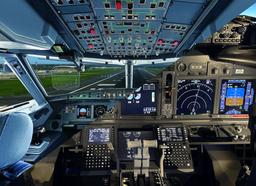
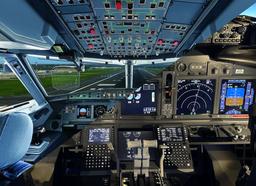
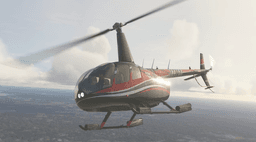
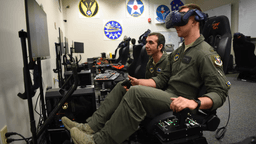
Short answer: No simulator wins outright. X-Plane's blade element flight model is the most physically accurate for civilian helicopters; DCS World has the deepest military helicopters (Huey, Mi-8, Kiowa, Apache) with outstanding flight models on its best modules; MSFS 2024 has the weakest helicopter physics of the three but unmatched scenery for scenic and real-world flying.
Simulating a helicopter is hard. Not "challenging game mechanic" hard—hard in the way that makes aerospace engineers reach for differential equations and computational fluid dynamics. The physics that keep a helicopter in the air are fundamentally more complex than those governing a fixed-wing aircraft, and every flight simulator handles them differently.
DCS World, Microsoft Flight Simulator 2024, and X-Plane each take a distinct approach to rotary-wing flight modelling. Each gets some things right and other things wrong. And the community debates about which one "wins" have been running for years with no resolution in sight.
This guide breaks down what makes helicopter simulation so difficult, how each platform approaches the problem, and which sim might be right for you depending on what you actually want to do with a virtual helicopter.
Affiliate disclosure: This guide contains affiliate links. If you purchase through these links, SimTuts earns a small commission at no extra cost to you. We only recommend products we genuinely believe improve the flight sim experience.
Why Helicopters Are Harder to Simulate Than Fixed-Wing Aircraft
A fixed-wing aircraft generates lift by moving forward through the air. The physics are relatively straightforward: angle of attack, airspeed, and wing geometry determine lift. Change one variable and the effects are mostly predictable.
A helicopter generates lift from spinning rotor blades—and this changes everything.
Dissymmetry of Lift
In forward flight, the advancing blade (moving into the airflow) sees a higher effective airspeed than the retreating blade (moving away from the airflow). At 150 knots forward speed with blade tips spinning at 400 knots, the advancing blade sees 550 knots while the retreating blade sees only 250 knots. Since lift increases with airspeed, the advancing side wants to generate far more lift than the retreating side.
Without compensation, this would roll the helicopter over. Real helicopters solve this through blade flapping—the advancing blade flaps upward, reducing its angle of attack, while the retreating blade flaps down, increasing its angle. The swashplate and cyclic feathering also play a role. A simulator must model all of this continuously for every blade position throughout each rotation.
Retreating Blade Stall
Push a helicopter fast enough and the retreating blade's effective airspeed drops so low that portions of it stall. This is the primary factor limiting helicopter maximum speed—not drag, not engine power, but the retreating blade running out of aerodynamic authority. The onset is progressive, starting at the blade tip and working inward, producing vibration and uncommanded roll before becoming unrecoverable.
Modelling this correctly requires tracking stall characteristics across the entire blade span at varying airspeeds—something that blade element theory handles naturally but simpler approaches must approximate.
Vortex Ring State
When descending vertically at moderate rates with power applied, the rotor can become engulfed in its own downwash vortices. The air recirculates through the rotor disc in a doughnut-shaped pattern, and the rotor effectively loses the ability to generate useful lift despite the engine running at full power.
Vortex ring state (VRS) is one of the most dangerous conditions in helicopter flight and has caused fatal accidents. It is also notoriously difficult to simulate correctly. As we'll see, none of the three major simulators get it entirely right.
Gyroscopic Precession
A spinning rotor acts as a gyroscope. When a force is applied to a gyroscope, the resulting movement occurs approximately 90 degrees later in the direction of rotation. This means that when you push the cyclic forward to tilt the rotor disc forward, the actual force application on each blade must occur 90 degrees earlier in its rotation. The swashplate is mechanically designed to account for this phase offset, but the simulator must model the underlying physics for the controls to feel correct.
Torque and Anti-Torque
Every action has an equal and opposite reaction. The engine spins the main rotor counter-clockwise when viewed from above (in most American helicopters like the UH-1H and AH-64), so the fuselage wants to spin clockwise viewed from above (nose left). The tail rotor counteracts this torque—but any change in power, collective pitch, or rotor RPM changes the torque, requiring constant pedal adjustments. Increase collective? More torque, need more left pedal. Reduce power? Less torque, need less left pedal.
This creates a multi-axis coupling that doesn't exist in fixed-wing flight. Every control input affects every other axis.
Translational Lift
At roughly 16-24 knots forward speed, the helicopter transitions through effective translational lift. Below this speed, the rotor is partially flying through its own disturbed downwash. Above it, the rotor moves into clean, undisturbed air and becomes significantly more efficient. The transition is non-linear—handling characteristics change noticeably, the nose tends to pitch up, and the helicopter may roll slightly.
Ground Effect
When hovering close to the ground, rotor downwash reflects off the surface back into the rotor disc, augmenting lift. This means a helicopter can hover at a lower power setting near the ground than at altitude. The effect diminishes with height (roughly disappearing above one rotor diameter) and with forward speed. The FAA's own training materials acknowledge that ground effect is difficult to predict theoretically—simulators must tune it empirically.
The Core Problem
A fixed-wing aircraft is inherently stable. Disturb it and it tends to return to its previous state. A helicopter is inherently unstable with highly coupled multi-axis dynamics. All four controls—cyclic pitch, cyclic roll, collective, and pedals—must be coordinated simultaneously, and changing any one affects the other three. The computational complexity of properly simulating this is orders of magnitude greater than fixed-wing aerodynamics.
This is why three different simulators, each developed by talented engineers, can produce three noticeably different experiences of what should be the same physical reality.
DCS World: The Military Helicopter Benchmark
DCS World offers eight helicopter modules, all military aircraft, each developed to a level of systems depth that no other simulator matches. The flight models use what Eagle Dynamics calls an "Advanced Flight Model" that calculates forces across multiple elements of the airframe—main rotor, tail rotor, fuselage, stabilisers, and undercarriage—with rotor simulation including individual blade flapping motions.
The Standouts
UH-1H Huey — Consistently regarded as the gold standard of DCS helicopter flight models. Real helicopter pilots praise its fidelity repeatedly on forums and in reviews. The Huey's flight model captures the heavy, mechanical feel of a 1960s utility helicopter. The high-inertia rotor is forgiving enough for learning but demanding enough to reward precision. If you want to learn what helicopter flying "feels like," the Huey is where most people start.
Mi-8MTV2 — A steep learning curve matched by exceptional realism. The Hip is a heavy, powerful transport helicopter with complex engine management. It rewards pilots who take the time to understand its quirks: the tendency to weathervane in crosswinds, the deceptive power margins at high altitude, the way it wallows if you let airspeed decay. Widely considered one of the best helicopter simulations ever made.
Mi-24P Hind — Faster and more responsive than the Mi-8, with a flight model that captures the Hind's unique personality as a heavily armed helicopter that flies more like a fast attack aircraft than a traditional rotorcraft. Retreating blade stall is properly modelled at high speeds around 350 km/h—push the Hind too fast and you'll feel it.
OH-58D Kiowa Warrior — One of the newest additions and arguably the best-received helicopter in DCS. Reviews describe it as "the closest we have felt to properly flying a real helicopter in DCS." Vortex ring state, retreating blade stall, and translational lift are all accurately modelled. The Kiowa's light weight and responsive controls make it feel distinctly different from the heavier DCS helicopters.
Ka-50 Black Shark III — A unique aircraft with coaxial counter-rotating rotors, which eliminates the need for a tail rotor and the associated torque management. This makes it relatively easy to fly compared to conventional helicopters, but the flight characteristics are authentic to the real Ka-50. The advanced autopilot system can handle much of the workload, making it accessible for beginners while still offering depth.
The Controversial Ones
AH-64D Apache — The most debated flight model in DCS. Eagle Dynamics employs several former AH-64D pilots and has invested heavily in accuracy, but the community remains divided. Common criticisms include the aircraft feeling underpowered, excessive yaw instability, and a lack of proper momentum and inertia. The flight model has been flagged as "being revised" by the developers. The systems modelling—the radar, the weapons, the sensor suite—is outstanding. The debate is specifically about how it feels to fly.
SA342 Gazelle — Historically the most criticised module in DCS, developed by third-party studio Polychop Simulations. Earlier versions were described as feeling "on rails" with physics that didn't match real helicopter behaviour. A 2023 overhaul improved things significantly, but reports from early 2025 indicate that Polychop's development team left the company, leaving unresolved bugs and an uncertain future.
What DCS Gets Right and Wrong
DCS's strength is depth. Each helicopter is a complete simulation of a specific real-world aircraft, with accurate cockpit systems, realistic engine management, and detailed weapon integration. No other platform comes close for military helicopter operations.
The weakness is inconsistency. Because each module has a separate flight model implementation, quality varies. The Huey and Kiowa feel sublime. The Apache and Gazelle have frustrated real pilots. And the community's analysis suggests that DCS enters vortex ring state too easily in several modules—though the Kiowa appears to get it right.
MSFS 2024: Visual Immersion Meets Growing Pains
Microsoft Flight Simulator 2024 was the first version to ship with helicopters as standard aircraft. Previous versions only added rotary-wing support through the 2020 40th Anniversary Edition update. The default lineup includes the Bell 407, Guimbal Cabri G2, Airbus H125, Robinson R66, S-64F Air Crane, and a MagniGyro autogyro, with the Premium Deluxe edition adding the Airbus H225 and CH-47 Chinook.
The Flight Model Approach
MSFS uses a stability-derivative approach rather than blade element theory. In simplified terms, this means the simulator uses pre-calculated coefficients to describe how the aircraft responds to control inputs and environmental conditions, rather than computing forces on individual blade elements in real time. This is computationally cheaper and works well for fixed-wing aircraft, but it's a less physically rigorous approach for rotorcraft where blade-level phenomena (retreating blade stall, dissymmetry of lift) emerge naturally from the physics rather than being approximated.
What Works
The Robinson R66 (by Carenado) is considered the strongest default helicopter, with a flight model that real pilots have described as "very good." The Asobo H125 is generally well-received as realistic and pleasant to fly. Third-party developers have pushed quality further—the CowanSim H125 and HPG H145 are both highly regarded in the community.
The overwhelming advantage of MSFS is visual immersion. Helicopters operate at low altitude where scenery quality matters enormously—and no simulator comes close to MSFS for photogrammetry cities, detailed terrain, and worldwide coverage. Flying a helicopter through a mountain valley or between skyscrapers in MSFS is a genuinely stunning experience that adds to the sense of actually being there.
Sim Update 4 brought meaningful improvements to rotational dynamics, fixing issues with angular momentum conservation and ground-effect interactions.
What Doesn't Work
The Nemeth Design Bell 407 is widely criticised, with users reporting an inability to execute basic helicopter turns properly. A "pinnacle bug" that causes helicopters to spin violently when flying over elevated helipad edges was fixed once and then regressed in a later update.
SU4 added VRS protection assistance to MSFS, though the underlying VRS modelling remains basic compared to DCS or X-Plane. VRS is one of the most critical phenomena in rotary-wing flight and a core part of real helicopter training. Autorotation modelling is basic compared to DCS or X-Plane. The underlying physics engine was designed for fixed-wing aircraft and adapted for rotorcraft, and that heritage shows in edge cases.
The MSFS Trajectory
MSFS helicopter support is clearly improving. Asobo is actively updating the flight model, the third-party marketplace is growing rapidly, and each sim update has addressed specific rotary-wing issues. If you're evaluating MSFS for helicopters today, know that it will likely be a meaningfully better helicopter platform in a year's time.
X-Plane: The Physics Purist
X-Plane's marketing has always led with its flight model, and for helicopters this distinction matters. X-Plane is the only major simulator that uses blade element theory (BET) as its core approach to flight modelling.
Blade Element Theory Explained
Rather than using pre-calculated response curves, X-Plane breaks each rotor blade into small sections and calculates the aerodynamic forces on each section many times per second, based on its local angle of attack, airspeed, and position relative to the airflow. The result is that complex helicopter phenomena—translational lift, ground effect, retreating blade stall, autorotation—emerge naturally from the simulation rather than being explicitly programmed.
X-Plane 12 specifically introduced "next-generation rotor physics" with refined ground effect modelling where pressure waves diminish realistically with speed, and effective translational lift is modelled as stronger than ground effect—matching real-world aerodynamics.
Available Helicopters
X-Plane ships with a Robinson R22 that reviewers have described as "one of the best default helicopters in any simulator." The third-party ecosystem is smaller than MSFS but includes exceptional developers:
DreamFoil Creations builds what many consider the best civilian helicopter add-ons available on any platform. Their Bell 407, AS350/H125, R22, Bell 206, and Schweizer S300 are all praised for taking full advantage of X-Plane's blade element theory foundation.
VSKYLABS produces uniquely detailed simulations including the Robinson R44, Mini-500, and several experimental designs. Their models simulate advanced phenomena that other add-ons skip: manual engine and rotor RPM management, low rotor-inertia behaviour, nose tuck during engine failure, mast bumping, and detailed autorotation dynamics.
What X-Plane Gets Right and Wrong
The flight dynamics are widely considered the strongest of the three platforms for pure rotary-wing physics. Blade element theory produces naturally realistic behaviour across the flight envelope without the tuning and approximation that stability-derivative approaches require.
However, blade element theory has limitations at the extremes. Developers have noted that while BET "gets you the basics" convincingly, achieving higher-fidelity results "becomes hard because you need to do all sorts of hacks and fudges to tune it." Vortex ring state is modelled in X-Plane, but the implementation allows pilots to exit VRS using collective input alone—which shouldn't work in reality and represents a significant inaccuracy.
X-Plane's other limitation for helicopter flying is scenery quality. Helicopters operate at low altitude where ground detail matters, and X-Plane's visual environment is noticeably behind MSFS. For missions where the view out the window is part of the experience—medevac in mountain terrain, offshore oil rig operations, urban flying—this matters.
Head-to-Head Comparison
| Aspect | DCS World | MSFS 2024 | X-Plane 12 |
|---|---|---|---|
| Flight model approach | Advanced multi-element | Stability derivatives | Blade element theory |
| Flight model fidelity | Excellent (varies by module) | Improving, weakest of three | Excellent |
| Vortex ring state | Modelled (too easy to enter) | Basic (SU4 added VRS assistance) | Modelled (broken exit) |
| Autorotation | Good | Basic | Good |
| Ground effect | Good | Present but basic | Good (improved in XP12) |
| Retreating blade stall | Modelled in several modules | Not explicitly modelled | Emergent from BET |
| Available helicopters | 8 military modules | 6-8 default + marketplace | R22 default + third-party |
| Systems depth | Exceptional | Basic to moderate | Moderate |
| Scenery quality | Limited maps | Best in class | Behind MSFS |
| VR support | Good | Good | Historically poor |
| Helicopter focus | Military combat operations | Civilian and career mode | Civilian training and realism |
| Price per helicopter | £30-60 per module | Included or marketplace | £20-40 third-party |
Get flight sim tips in your inbox
New guides, checklists, and tips — no spam. Unsubscribe any time.
No Simulator Gets Everything Right
It's worth being honest about this: every simulator has blind spots in its helicopter physics.
Vortex ring state is wrong everywhere. DCS enters it too easily in most modules (though the Kiowa gets it right). X-Plane lets you escape it incorrectly. MSFS doesn't model it at all. For a phenomenon that kills real helicopter pilots, this is a significant gap across the entire industry.
Autorotation works reasonably well in DCS and X-Plane but is basic in MSFS. None of the simulators fully capture the high-stakes, time-critical nature of real autorotation, though DCS's Huey comes closest.
Retreating blade stall is modelled in DCS (notably in the Mi-24P at high speed) and emerges naturally from X-Plane's blade element theory, but MSFS doesn't explicitly simulate it.
The reality is that simulating helicopter aerodynamics to full fidelity would require solving Navier-Stokes equations for the complex airflow around a spinning rotor—something that takes supercomputers hours to compute for a single flight condition. Every simulator makes compromises.
Which Sim Is Right for You?
Choose DCS World if you want to fly military helicopters with full systems depth. If learning the AH-64D Apache's fire control radar, flying CAS missions in a Hind, or mastering formation flying in a Huey appeals to you, nothing else comes close. The flight models for the best modules (Huey, Mi-8, Kiowa) are outstanding. Just be aware that module quality varies and each helicopter is a separate purchase.
Choose MSFS 2024 if visual immersion and worldwide flying matter most to you. If you want to fly a helicopter through the Grand Canyon, practice approaches to real-world hospital helipads, or simply enjoy the sensation of low-level flight over photorealistic scenery, MSFS delivers an experience the others can't match. The flight model is the weakest of the three for helicopters specifically, but it's actively improving and the third-party marketplace is growing fast.
Choose X-Plane if flight model accuracy is your top priority and you primarily want civilian helicopter operations. The blade element theory foundation means the basic physics are the most correct, and developers like DreamFoil and VSKYLABS build add-ons that take full advantage of this. If you're using the simulator for training concepts or want to understand how helicopters actually fly, X-Plane's approach produces the most physically honest results.
Or fly all three. Many serious helicopter sim pilots own modules across multiple platforms and use each for different purposes—DCS for combat, MSFS for scenic flying, X-Plane for training and physics accuracy. The sims complement each other more than they compete.
Frequently Asked Questions
What is the best helicopter flight simulator?
There is no single winner — it depends on what you want to do. For the most accurate rotary-wing physics, X-Plane 12 leads, thanks to its blade element theory flight model. For military helicopters with full systems depth, DCS World is unmatched. For scenic and civilian flying over photoreal scenery, MSFS 2024 wins on immersion, despite having the weakest helicopter flight model of the three — a gap it is closing with every sim update. If you only fly one, pick the sim that matches your mission: accuracy (X-Plane), combat (DCS), or scenery (MSFS).
What is the best helicopter in MSFS 2024?
Of the default aircraft, the Robinson R66 has the strongest flight model — real pilots have described it as very good — with the Asobo H125 a close, pleasant second. Third-party add-ons go further: the CowanSim H125 and CowanSim R66 are widely regarded as more refined than the defaults, and the HPG H145 is the pick for systems depth. Avoid the Nemeth Design Bell 407, which is widely criticised for handling problems.
Is DCS or MSFS better for helicopters?
For flight-model accuracy and systems depth, DCS is clearly ahead — its Huey, Mi-8, and Kiowa are among the best helicopter simulations ever made. For scenery, worldwide coverage, and civilian flying, MSFS 2024 is better, and it is the easier place to start. Many helicopter simmers own both: DCS for combat and serious flying, MSFS for scenic low-level flight. If your priority is learning how a helicopter actually flies, DCS (or X-Plane) models the tricky phenomena — vortex ring state, retreating blade stall, autorotation — far more faithfully than MSFS.
Getting Started with Helicopter Flying
Whichever simulator you choose, helicopter flying has a steeper learning curve than fixed-wing. The coupled multi-axis controls, the inherent instability, and the need to coordinate all four inputs simultaneously make it one of the most challenging skills in flight simulation.
The good news is that the learning curve is also one of the most rewarding. Successfully hovering a helicopter for the first time—actually holding position in a crosswind without drifting, climbing, or spinning—is one of the most satisfying moments in sim flying. And unlike fixed-wing basics, which many pilots pick up intuitively, helicopter fundamentals genuinely reward deliberate, structured practice — short hover sessions with a clear goal beat hours of aimless flying, and reviewing your own replays catches bad habits before they become permanent.
A note on hardware: Helicopter flying lives in your feet and your left hand. A set of rudder pedals makes anti-torque and hover work far more controllable than twisting a stick for yaw, and a HOTAS stick-and-throttle set gives you a proper cyclic plus a throttle lever you can map to the collective. Because helicopters operate low and slow where looking out of the window matters most, head-tracking with TrackIR adds more here than in almost any other kind of flying. Ready to invest? MOZA's MRP rudder pedals give the smooth, damped anti-torque travel that hover work depends on, and the AB6 force-feedback base with the MH16 flightstick loads the cyclic so you feel the aircraft drift instead of guessing from the horizon.